Books like Yesteryear
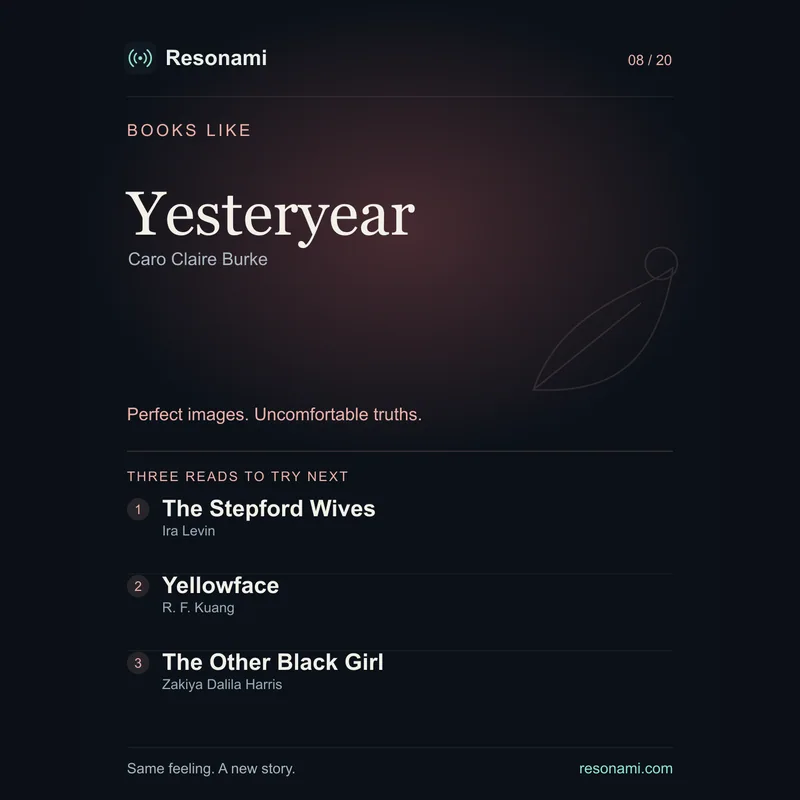
Perfect images. Uncomfortable truths.
Starting with Yesteryear by Caro Claire Burke
Title details on Open Library ↗
What should I read after Yesteryear?
For Yesteryear fans, these three books offer different ways forward: The Stepford Wives (The ideal household as a threat); Yellowface (An opportunist narrating herself); The Other Black Girl (Belonging inside a polished workplace). Each comparison below explains the connection and where the experience differs.
Yesteryear turns the performance of a desirable life into a source of unease. If its identity politics and dark humor interested you, a follow-up might examine an idealized household, an opportunist defending a fabricated account, or a workplace where belonging has conditions nobody states plainly.
The Stepford Wives is the most direct domestic and gendered comparison. Yellowface takes performance into publishing and authorship. The Other Black Girl makes a professional setting increasingly unsettling. These are three different satirical mechanisms, rather than predictions of the same plot or resolution.
Which direction interests you?
Start with the connection you want, then read the differences before choosing.
The Stepford Wives
A woman notices disturbing patterns in a suburban community’s expectations of its wives.
Title details on Open Library ↗Why it connects
The Stepford Wives makes apparent perfection feel less like an achievement than an imposed role. It connects through the question of whose needs are served by an image of effortless domestic happiness.
Where it differs
The older novel is short and concentrates its satire into suburban suspense. Its historical assumptions and speculative mechanism differ from Yesteryear’s contemporary media concerns.
Yellowface
A writer’s career becomes entangled with another author’s work and the account she offers of her own entitlement.
Title details on Open Library ↗Why it connects
Yellowface is a match for the energy of a self-presentation that becomes harder to sustain the more aggressively it is defended. Its narrator turns public judgment into a continuing private argument.
Where it differs
Publishing, race, and literary ownership are central. The contemporary social satire does not reproduce Yesteryear’s domestic or speculative premise.
The Other Black Girl
A young Black woman’s publishing job becomes more complicated when another Black woman joins the office.
Title details on Open Library ↗Why it connects
The Other Black Girl connects professional performance to the fear that acceptance may require a damaging bargain. Familiar workplace rituals become clues to a system whose promises deserve scrutiny.
Where it differs
Race and institutional assimilation are central, with an unsettling genre shift. The focus is office life rather than a public image of family and motherhood.
These are editorial comparisons of themes, tone, and storytelling, rather than a numerical ranking or personalized results. Title identities were checked against the linked catalog or publisher records on October 26, 2026. The connections and differences are Resonami’s analysis. Sources provide title context; availability and editions can vary. Read our editorial approach and corrections policy.
For translated books, style can also vary by translation. Series starters may leave a larger story to continue.