Books like The Correspondent
Letters. Connection. Second chances.
Starting with The Correspondent by Virginia Evans
Title details on Open Library ↗
What should I read after The Correspondent?
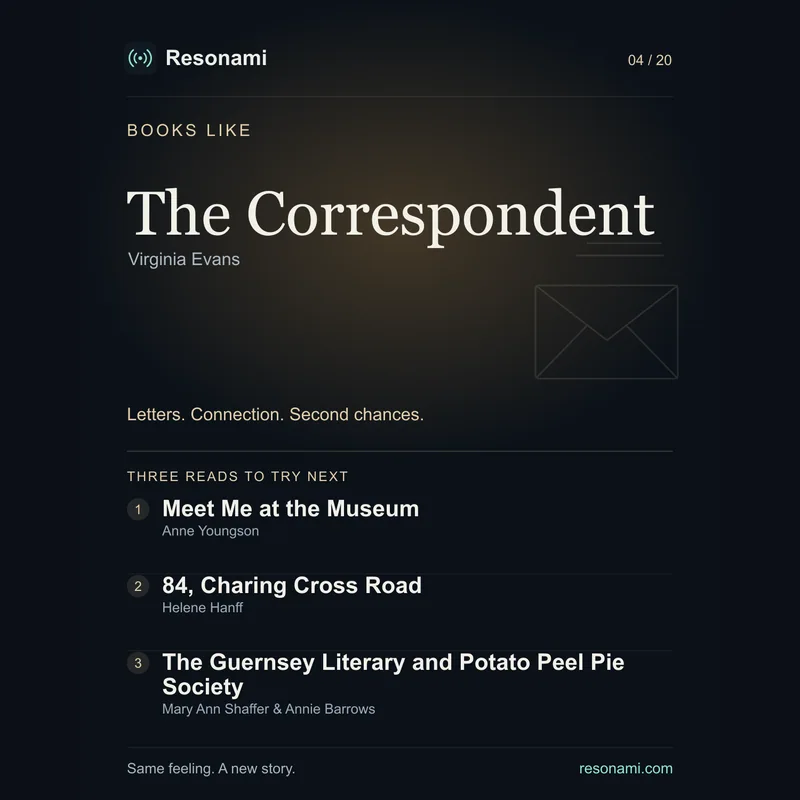
For The Correspondent fans, these three books offer different ways forward: Meet Me at the Museum (A connection begun at a distance); 84, Charing Cross Road (A real friendship through books); The Guernsey Literary and Potato Peel Pie Society (A community revealing its history). Each comparison below explains the connection and where the experience differs.
The Correspondent uses letters to reveal a life through the people who receive its accounts, requests, and omissions. A similar read can preserve that intimacy without copying the same central voice. The form matters: correspondence makes silence and delay part of a relationship.
Meet Me at the Museum offers a late-life connection through an exchange. 84, Charing Cross Road is nonfiction correspondence about books and friendship. The Guernsey Literary and Potato Peel Pie Society builds a wider fictional community. Choose between a small developing bond and a larger network of voices.
Which direction interests you?
Start with the connection you want, then read the differences before choosing.
Meet Me at the Museum
A correspondence develops between people whose ordinary lives have left room for unanswered questions.
Title details on Open Library ↗Why it connects
Meet Me at the Museum gives written attention the force of an event. It fits readers who liked the idea that another person’s careful response can alter how a familiar life is understood.
Where it differs
The exchange is more concentrated around two correspondents and their developing connection. It is a novel with a different social setting and emotional trajectory.
84, Charing Cross Road
Helene Hanff’s exchanges with a London bookseller and others record an enduring relationship across the Atlantic.
Title details on Open Library ↗Why it connects
84, Charing Cross Road shares the pleasure of character emerging through practical requests, jokes, and small acts of generosity. The written exchange becomes a meaningful part of everyday life.
Where it differs
This is nonfiction correspondence, so do not expect a novel’s engineered resolutions. Book collecting, postwar circumstances, and the short form give it a distinct texture.
The Guernsey Literary and Potato Peel Pie Society
A writer’s postwar letters bring her into contact with residents of Guernsey and their experiences of occupation.
Title details on Open Library ↗Why it connects
The Guernsey Literary and Potato Peel Pie Society uses many voices to make belonging visible. It suits readers who want correspondence to open outward into a community rather than remain a private exchange.
Where it differs
Mary Ann Shaffer and Annie Barrows give the letters a historical and romantic framework. Wartime memory and a larger ensemble create a broader narrative than a single correspondent’s life.
These are editorial comparisons of themes, tone, and storytelling, rather than a numerical ranking or personalized results. Title identities were checked against the linked catalog or publisher records on October 26, 2026. The connections and differences are Resonami’s analysis. Sources provide title context; availability and editions can vary. Read our editorial approach and corrections policy.
For translated books, style can also vary by translation. Series starters may leave a larger story to continue.