Movies like The Matrix
Constructed realities and the question of who controls the self.
Starting with The Matrix (1999)
Title details on TMDB ↗
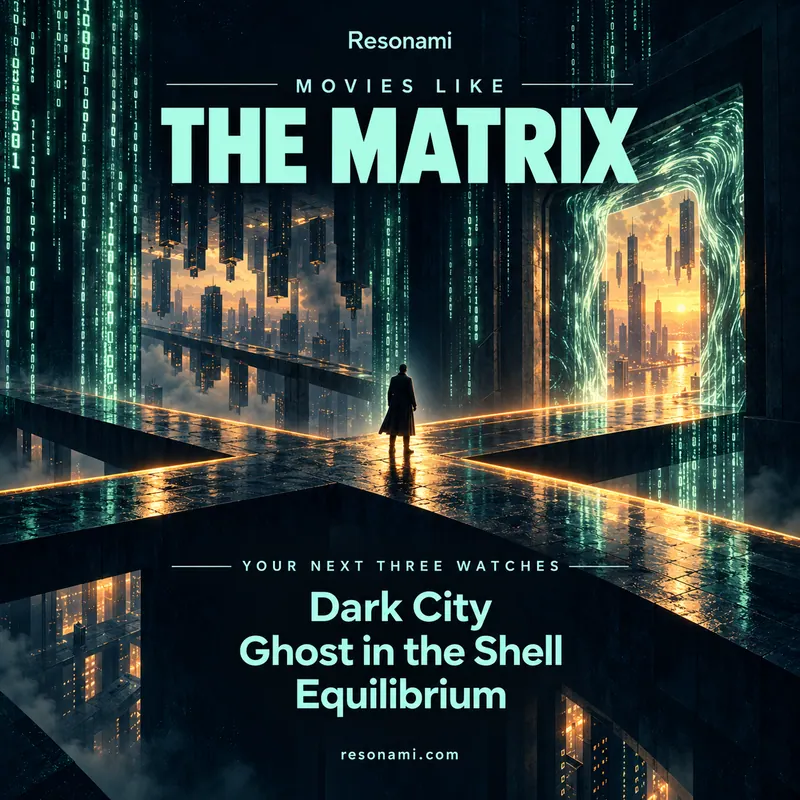
What should I watch after The Matrix?
For The Matrix fans, these three movies offer different ways forward: Dark City (Reality as an investigation); Ghost in the Shell (Identity beyond the body); Equilibrium (Stylized rebellion). Each comparison below explains the connection and where the experience differs.
The Matrix combines a reality-revealing premise with martial-arts spectacle. Those pleasures can lead to quite different recommendations: a detective story about a counterfeit world, a philosophical animation about consciousness, or an action film about rebellion under an authoritarian regime.
Dark City is the atmospheric choice, Ghost in the Shell the most reflective, and Equilibrium the most directly action-driven. The Ghost in the Shell recommendation is the 1995 animated film, rather than the later live-action adaptation or television continuities.
Which direction interests you?
Start with the connection you want, then read the differences before choosing.
Dark City
A nocturnal city becomes a puzzle about memory, identity, and control.
Title details on TMDB ↗Why it connects
Dark City shares the disorienting discovery that ordinary life may be an imposed arrangement. Its protagonist has to question memory and surroundings before he can understand the power structure governing them.
Where it differs
The visual language is noir: dark streets, enclosed spaces, and suspicion. Gunplay and martial arts are less central than in The Matrix.
Ghost in the Shell
The original animated film explores consciousness in a cybernetic world.
Title details on TMDB ↗Why it connects
Ghost in the Shell connects through the uneasy boundary between a person and the technology carrying that person’s experience. Its questions about memory and autonomy give the reality puzzle philosophical depth.
Where it differs
The 1995 film is quieter, shorter, and more contemplative. Expect stretches of visual reflection rather than a constant progression of action set pieces.
Equilibrium
Stylized action meets a dystopia that tries to suppress human emotion.
Title details on TMDB ↗Why it connects
Equilibrium follows an enforcer whose relationship to a controlled society begins to change. The appeal is the tension between learned obedience and emerging feeling, expressed through highly choreographed combat.
Where it differs
Its dystopia is openly authoritarian rather than a hidden simulation. The world-building is more schematic, with action doing much of the expressive work.
These are editorial comparisons of themes, tone, and storytelling, rather than a numerical ranking or personalized results. Title identities were checked against the linked catalog or publisher records on October 25, 2026. The connections and differences are Resonami’s analysis. Sources provide title context; availability and editions can vary. Read our editorial approach and corrections policy.
Dates distinguish the film or original series being discussed. A similar premise can still mean a very different level of violence or intensity.