Books like The Intruder
Isolated shelter. Uncertain trust.
Starting with The Intruder by Freida McFadden
Title details on Open Library ↗
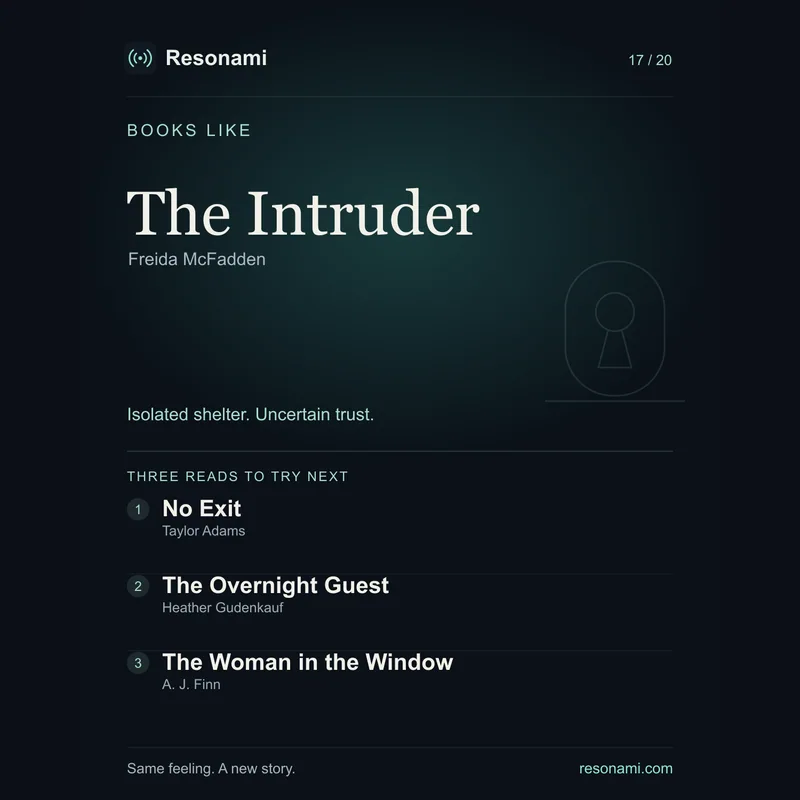
What should I read after The Intruder?
For The Intruder fans, these three books offer different ways forward: No Exit (Strangers and a shrinking set of options); The Overnight Guest (A remote place with an unresolved history); The Woman in the Window (Safety limited by uncertain perception). Each comparison below explains the connection and where the experience differs.
The Intruder makes shelter uncertain: an isolated place can protect someone from the world while also limiting the possibility of help. These follow-ups preserve different sources of pressure, from being trapped with strangers to a remote guesthouse and the unreliable safety of observing from home.
No Exit is the most immediate race against danger. The Overnight Guest combines isolation with an unfolding history. The Woman in the Window puts perception and credibility at the center. They share suspense without relying on the same setting or the same kind of revelation.
Which direction interests you?
Start with the connection you want, then read the differences before choosing.
No Exit
A traveler stranded by a snowstorm at a rest stop discovers a situation requiring dangerous intervention.
Title details on Open Library ↗Why it connects
No Exit connects isolation to the practical problem of not knowing whom to trust. It is a good choice when you want a thriller to make each available action feel urgent and increasingly constrained.
Where it differs
Taylor Adams favors relentless external suspense and graphic violence. The compressed rest-stop situation has less room for a long domestic relationship mystery.
The Overnight Guest
A writer in an isolated house becomes involved in a troubling discovery during severe weather.
Title details on Open Library ↗Why it connects
The Overnight Guest makes weather and distance limits on both safety and knowledge. Its match is the feeling that a supposed retreat contains connections to a story the protagonist cannot yet see.
Where it differs
Heather Gudenkauf uses interwoven narrative strands and a different balance of past and present. The mystery has a wider temporal frame than a single immediate intrusion.
The Woman in the Window
A woman who spends much of her life at home believes she has witnessed something disturbing in a neighboring house.
Title details on Open Library ↗Why it connects
The Woman in the Window connects the familiar interior to vulnerability and doubt. Choose it for suspense about whether an observation can be trusted, communicated, or acted on from a constrained position.
Where it differs
A. J. Finn’s urban setting replaces remote wilderness. Agoraphobia, memory, and credibility are more central than physical distance from possible help.
These are editorial comparisons of themes, tone, and storytelling, rather than a numerical ranking or personalized results. Title identities were checked against the linked catalog or publisher records on October 26, 2026. The connections and differences are Resonami’s analysis. Sources provide title context; availability and editions can vary. Read our editorial approach and corrections policy.
For translated books, style can also vary by translation. Series starters may leave a larger story to continue.