Books like My Husband’s Wife
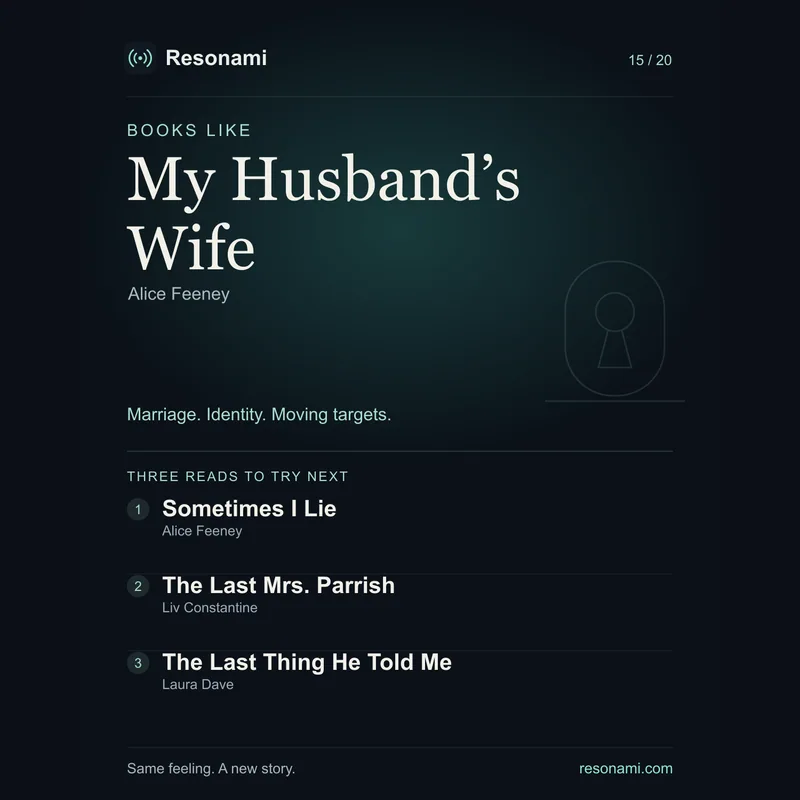
Marriage. Identity. Moving targets.
Starting with My Husband’s Wife by Alice Feeney
Title details on Open Library ↗
What should I read after My Husband’s Wife?
For My Husband’s Wife fans, these three books offer different ways forward: Sometimes I Lie (A perspective with missing context); The Last Mrs. Parrish (Wealth and the performance of marriage); The Last Thing He Told Me (Investigating while protecting a family). Each comparison below explains the connection and where the experience differs.
Alice Feeney’s My Husband’s Wife makes the certainty of a familiar home and relationship suddenly questionable. A follow-up can preserve that loss of interpretive footing, the social performance of a marriage, or the need to investigate a partner whose account can no longer be taken for granted.
Sometimes I Lie returns to Feeney’s carefully managed uncertainty. The Last Mrs. Parrish makes wealth and manipulation central. The Last Thing He Told Me places a protective family relationship beside the investigation. These are different mechanisms of mistrust, with the comparisons kept free of ending spoilers.
Which direction interests you?
Start with the connection you want, then read the differences before choosing.
Sometimes I Lie
A woman’s uncertain account of her circumstances gradually exposes more than the situation initially appears to allow.
Title details on Open Library ↗Why it connects
Sometimes I Lie is the direct choice for Feeney’s manipulation of a reader’s confidence. It rewards attention to what an account leaves unexplained as well as to the information it openly provides.
Where it differs
The narrator’s situation and the organization of time differ from the disputed household in My Husband’s Wife. Expect a new construction rather than the same puzzle in another house.
The Last Mrs. Parrish
An outsider becomes involved with a wealthy couple whose apparent success attracts close attention.
Title details on Open Library ↗Why it connects
The Last Mrs. Parrish connects the desire to enter an enviable life to the difficulty of knowing it from outside. Status gives the visible version of a relationship more persuasive power than it deserves.
Where it differs
Liv Constantine emphasizes ambition and strategic manipulation. Its social world and narrative balance differ from Feeney’s more directly disorienting opening premise.
The Last Thing He Told Me
A woman and her stepdaughter confront questions about a missing man and the life they believed they shared.
Title details on Open Library ↗Why it connects
The Last Thing He Told Me matches the need to rebuild trust from incomplete evidence about a partner. The investigation matters because the remaining family relationship must continue while the answers are uncertain.
Where it differs
Laura Dave gives the stepfamily bond a central emotional role. The tone is generally more relationship-focused than a succession of destabilizing perspective tricks.
These are editorial comparisons of themes, tone, and storytelling, rather than a numerical ranking or personalized results. Title identities were checked against the linked catalog or publisher records on October 26, 2026. The connections and differences are Resonami’s analysis. Sources provide title context; availability and editions can vary. Read our editorial approach and corrections policy.
For translated books, style can also vary by translation. Series starters may leave a larger story to continue.